At HIPUganda we are all about time and how – particularly photographically – documented snippets of it allow us to position ourselves in relation to pasts lived by our ancestors and others who inlfuenced our present day lives. We do not particularly care about specific dates, because what may have been a significant moment in the flow of time for one person – because of a death, thanks to a birth – may be utterly irrelevant to someone else. This is not only true for moments in individual lives, but also for collective memory. Thinking of ‘collective’ as a singular entity would, we think, be a grave mistake.
Nevertheless, the historical photographs encountered, digitized, shared, exhibited, activated, contributed by the sheer virtue of availability through unrestricted distribution, to shared, perhaps even collective forms of memory.
Over the past thirteen-and-a-half years (speaking of random time frames) of our existence, our focus slowly but surely shifted. We started digitising photographs, and shared them on social media and in exhibitions. This was an experiment, an effort to learn whether this might help to bring to the fore elements of Uganda’s history beyond the rather limited readily available documentation.
An example of such a resource would be the book Uganda – A Picture History 1857-2007, first published by Fountain Publishers in conjuction with the Commonwealth Heads of Goverment Meating in Kampala. This publication is a point in place in terms of the relativity of dates. In his 2017 book A History of Modern Uganda, British historian Richard Reid wonders why 1857 was chosen as a starting date, since it does not appear to have a particular relevance within the grand history of the territory that was to become Uganda. He failed to make the connection to CHOGM, an event that would change the face of Kampala forever, through for instance road (re)constructions and the rapid construction of hotels and other strcutures facilitating the meeting.
Much has changed since August 2011, when R. Canon Griffin and I, Andrea Stultiens – after careful consideration – chose History in Progress Uganda as the name of our platform despite the potentially toxic associations the word ‘progress’ might have in relation to modernist, emperial, colonial ideas of moving forward. For us, progress signifies not something linear but the change resulting from the fluidity of relations between the present and the past. How we are able to read and, perhaps, identify with what photographs show depends on context. Context changes for each encounter with a depiction of the past. Someone may or may not have paid attention in history class, someone’s family may or may not have had to deal with personal losses due to political turmoils in the country.
In 2011, Facebook was the most thriving social media platform in Uganda, and owning a camera was relatively rare. Both conditions changed dramatically. While less in the hands of ‘everyone’ than some people in Europe might think, ownership of smartphones with descent cameras capable of instant reproduction of photographs is ubiquitous. The infamous Over-The-Top (OTT) taxing of social media use that was in effect from 2018 till 2021, and the more or less subsequent governmental Facebook ban in Uganda of course affected the relevance of the social medium.
Due to a combination of these factors and developments in the personal interest of the HIPUganda core team, reproduction and distribution are no longer our primary concern. This does not mean we no longer are engaged in these activities, but that our focus has somewhat shifted towards critically investigating – and engaging in – modes of ‘activation’ of ‘archives’ and presentation of those activations. Such activations could be exhibitions as well as online or in print publication.
Non of this is particularly new to our practice. We already worked with numerous artists and others interested in Ugandan history at large, and historical photographs in particular. But, the shift is there, triggered – once more – by technological developments as well as personal interests.
From here onward we will be thinking out loud in and through our practice. Are thinking and making will be concerned with the networked relations between conservation, activation and presentation of of photographically documented lived experiences in the present. We continue to do this in an collaborative mode, and spirit of commoning. This means we are always open to work with external input and contributions and hope that this can happen in a spirit of mutuality.
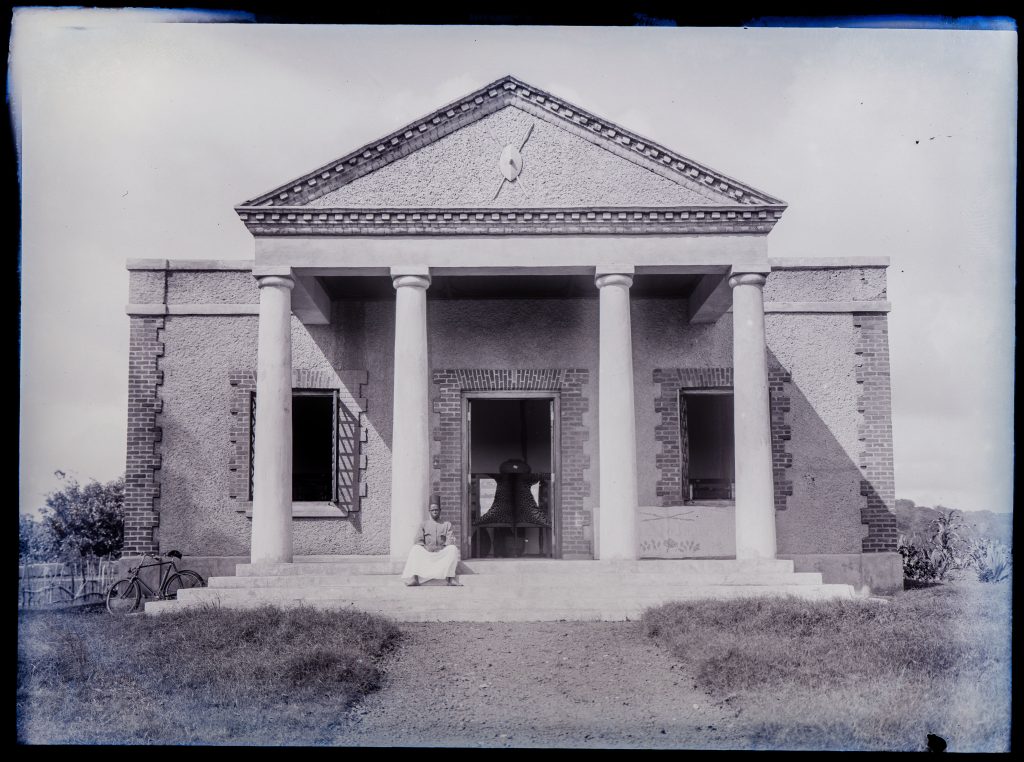
This blogpost is accompanied, ‘framed’ if you will, by digital pictures of two glassplate negatives that both materialise and illustrate our focus for the foreseeable future in their intricate and complex presence and referential potential.
The plates measure 130x180x2mm. They arrived with us (more on that in a later post) in glassine envelopes, and were, with and without these envelopes, photographed on a light box. The resulting digital images of the negatives were inverted and edited in Photoshop.
If you see this blogpost on your phone, the size of the image objects will have been brutally reduced, obscuring some of the detail captured on the large size negatives. You may want to make an effort to see them by zooming in…
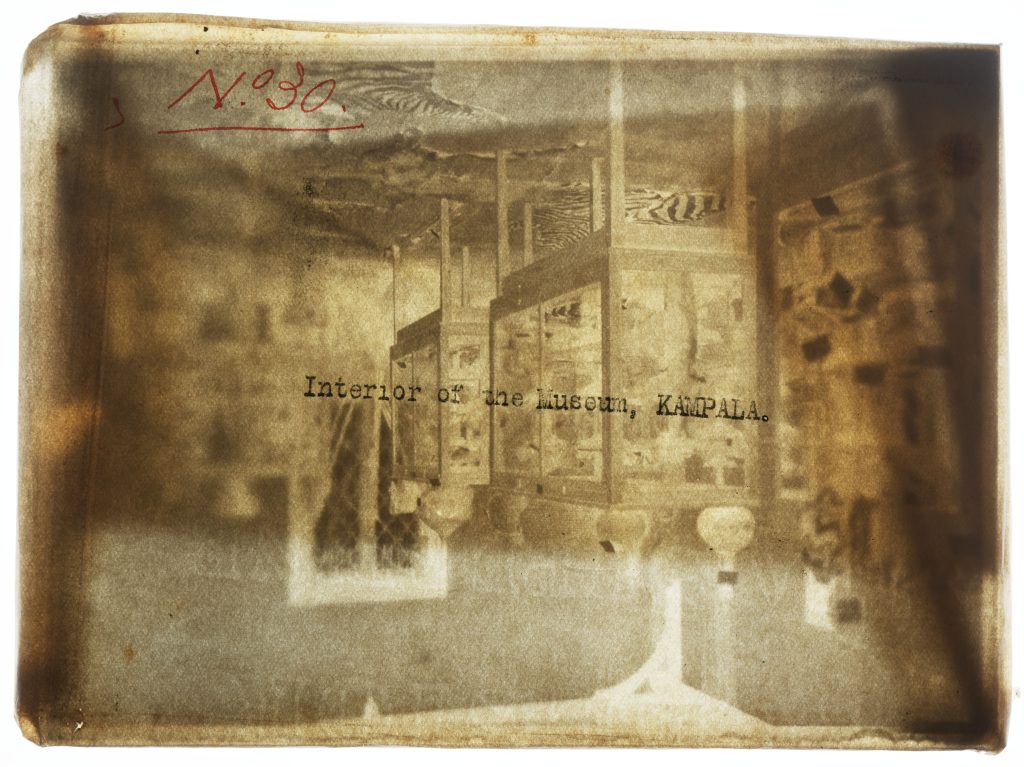
The pictures depict the exterior and interior of Lugard’s fort around 1919. At the time the building functioned as the first iteration of the Uganda Museum, established in 1908. The former colonial administrative building now was a (still colonial) facility of documentation and information through presentation. The photographs give a glimpse onto a colonial mode of display of ‘culture’ and history. This glimpse was made possible thanks to an acquisition on eBay, that we will get back to in a later blogpost. Just like we will return to (other) photographs produced by the same maker – who we identified as colonial botanist and forestry officer Robert Fyffe, the position of the man seated on the steps leading to the entrance and his function with this and other photographs.
We will use these blogs to self-publish narratives that are too long and detailed for social media. The medium to long read format allows us to elaborate on historical details as well as the interest we have in the photographs as a medium, as a phenomenon beyond the information it carries in its depiction. We will write about the photographs as historical materials as well as historical pictures that landed in our care, such as these two glassplate negatives. Our active engagement with and interventions in these collections are of course also brought to the fore. We navigate between documentation and activation of historical materials. We will question the often institutional entities that archives and museums are in terms of what cultural theorist Ariella Azoulay has called ‘potential history‘, and how photographs function within and in relation to them, and hope you will enjoy the journey.
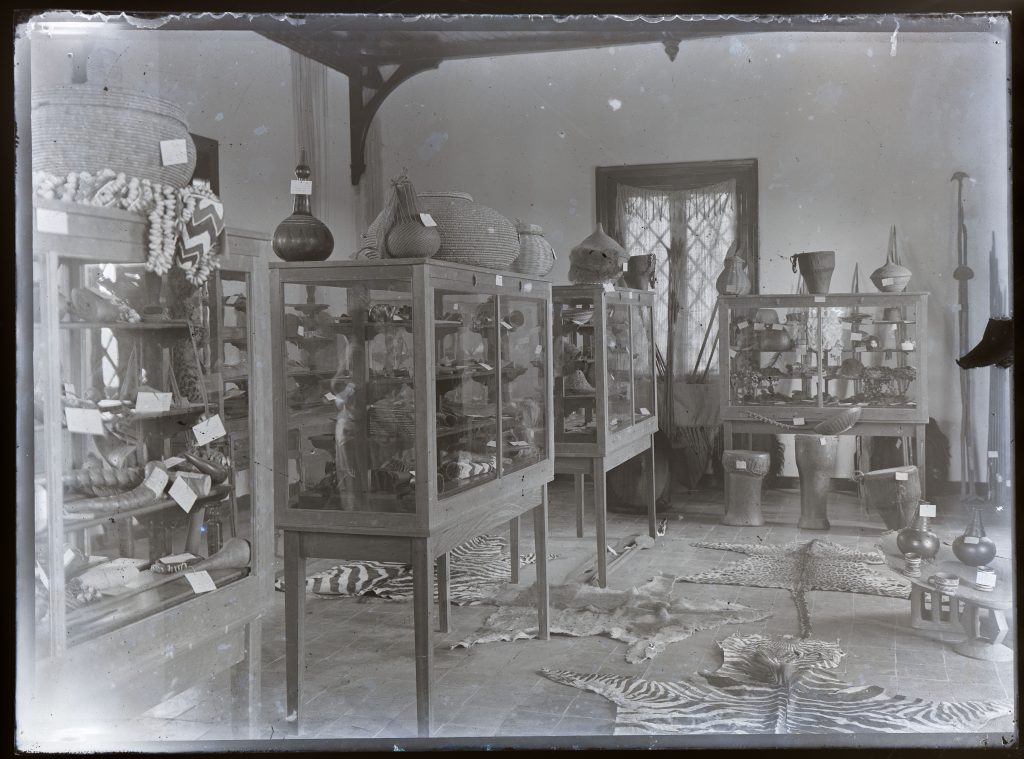
p.s. We have a hunch that we will be returning to these images and their details over time, as we visit and discuss other museums that have emerged over recent years in Uganda, as the current Uganda Museum opens its doors again to the public after the currently ongoing exhibition. Stay tuned (but don’t hold your breath).
At HIPUganda we are all about time and how – particularly photographically – documented snippets of it allow us to position ourselves in relation to pasts lived by our ancestors and others who inlfuenced our present day lives. We do not particularly care about specific dates, because what may have been a significant moment in the flow of time for one person – because of a death, thanks to a birth – may be utterly irrelevant to someone else. This is not only true for moments in individual lives, but also for collective memory. Thinking of ‘collective’ as a singular entity would, we think, be a grave mistake.
Nevertheless, the historical photographs encountered, digitized, shared, exhibited, activated, contributed by the sheer virtue of availability through unrestricted distribution, to shared, perhaps even collective forms of memory.
Over the past thirteen-and-a-half years (speaking of random time frames) of our existence, our focus slowly but surely shifted. We started digitising photographs, and shared them on social media and in exhibitions. This was an experiment, an effort to learn whether this might help to bring to the fore elements of Uganda’s history beyond the rather limited readily available documentation.
An example of such a resource would be the book Uganda – A Picture History 1857-2007, first published by Fountain Publishers in conjuction with the Commonwealth Heads of Goverment Meating in Kampala. This publication is a point in place in terms of the relativity of dates. In his 2017 book A History of Modern Uganda, British historian Richard Reid wonders why 1857 was chosen as a starting date, since it does not appear to have a particular relevance within the grand history of the territory that was to become Uganda. He failed to make the connection to CHOGM, an event that would change the face of Kampala forever, through for instance road (re)constructions and the rapid construction of hotels and other strcutures facilitating the meeting.
Much has changed since August 2011, when R. Canon Griffin and I, Andrea Stultiens – after careful consideration – chose History in Progress Uganda as the name of our platform despite the potentially toxic associations the word ‘progress’ might have in relation to modernist, emperial, colonial ideas of moving forward. For us, progress signifies not something linear but the change resulting from the fluidity of relations between the present and the past. How we are able to read and, perhaps, identify with what photographs show depends on context. Context changes for each encounter with a depiction of the past. Someone may or may not have paid attention in history class, someone’s family may or may not have had to deal with personal losses due to political turmoils in the country.
In 2011, Facebook was the most thriving social media platform in Uganda, and owning a camera was relatively rare. Both conditions changed dramatically. While less in the hands of ‘everyone’ than some people in Europe might think, ownership of smartphones with descent cameras capable of instant reproduction of photographs is ubiquitous. The infamous Over-The-Top (OTT) taxing of social media use that was in effect from 2018 till 2021, and the more or less subsequent governmental Facebook ban in Uganda of course affected the relevance of the social medium.
Due to a combination of these factors and developments in the personal interest of the HIPUganda core team, reproduction and distribution are no longer our primary concern. This does not mean we no longer are engaged in these activities, but that our focus has somewhat shifted towards critically investigating – and engaging in – modes of ‘activation’ of ‘archives’ and presentation of those activations. Such activations could be exhibitions as well as online or in print publication.
Non of this is particularly new to our practice. We already worked with numerous artists and others interested in Ugandan history at large, and historical photographs in particular. But, the shift is there, triggered – once more – by technological developments as well as personal interests.
From here onward we will be thinking out loud in and through our practice. Are thinking and making will be concerned with the networked relations between conservation, activation and presentation of of photographically documented lived experiences in the present. We continue to do this in an collaborative mode, and spirit of commoning. This means we are always open to work with external input and contributions and hope that this can happen in a spirit of mutuality.
This blogpost is accompanied, ‘framed’ if you will, by digital pictures of two glassplate negatives that both materialise and illustrate our focus for the foreseeable future in their intricate and complex presence and referential potential.
The plates measure 130x180x2mm. They arrived with us (more on that in a later post) in glassine envelopes, and were, with and without these envelopes, photographed on a light box. The resulting digital images of the negatives were inverted and edited in Photoshop.
If you see this blogpost on your phone, the size of the image objects will have been brutally reduced, obscuring some of the detail captured on the large size negatives. You may want to make an effort to see them by zooming in…
The pictures depict the exterior and interior of Lugard’s fort around 1919. At the time the building functioned as the first iteration of the Uganda Museum, established in 1908. The former colonial administrative building now was a (still colonial) facility of documentation and information through presentation. The photographs give a glimpse onto a colonial mode of display of ‘culture’ and history. This glimpse was made possible thanks to an acquisition on eBay, that we will get back to in a later blogpost. Just like we will return to (other) photographs produced by the same maker – who we identified as colonial botanist and forestry officer Robert Fyffe, the position of the man seated on the steps leading to the entrance and his function with this and other photographs.
We will use these blogs to self-publish narratives that are too long and detailed for social media. The medium to long read format allows us to elaborate on historical details as well as the interest we have in the photographs as a medium, as a phenomenon beyond the information it carries in its depiction. We will write about the photographs as historical materials as well as historical pictures that landed in our care, such as these two glassplate negatives. Our active engagement with and interventions in these collections are of course also brought to the fore. We navigate between documentation and activation of historical materials. We will question the often institutional entities that archives and museums are in terms of what cultural theorist Ariella Azoulay has called ‘potential history‘, and how photographs function within and in relation to them, and hope you will enjoy the journey.
p.s. We have a hunch that we will be returning to these images and their details over time, as we visit and discuss other museums that have emerged over recent years in Uganda, as the current Uganda Museum opens its doors again to the public after the currently ongoing exhibition. Stay tuned (but don’t hold your breath).


